Thursday, April 2, 2009

John Cleese (1939- )

Best Known For: 
Fawlty Towers (Television Series), Monty Python's Flying Circus (Television Series), How to Irritate People (Film), Monty Python and the Holy Grail (Film), Monty Python's Life of Brian (Film), Monty Python's The Meaning of Life (Film), A Fish Called Wanda (Film).
Major Themes:
Physical Comedy, Surreal Comedy, Dark Comedy, English Culture, Character Humor
(Aron Wiegand)

America (The Book): A citizen's guide to Democracy Inaction

Stewart, Jon. "America (the book) a citizen's guide to democracy inaction". New York, NY: Warner Books, 2004.

Chapter three of America (the book), is entitled The President: King of Democracy. The chapter is set by a picture and quote by ex-president Richard M. Nixon, "[expletive deleted]". The book is designed to be a spoof of textbooks used in classrooms across the nation. The book is entirely farcical in nature, but does an decent job of outlining some of the main responsibilities and frustrations of being president. The book's textbook-like formatting gives room in the side columns for images and quotes which are almost always of a fabricated and comedic nature, the use of comic footnotes is also extremely common. The chapter focuses on the job of the president as being both powerful and full of perks, as well as a routinely hated public figure and all purpose scapegoat. The chapter has a very liberal spin and one of the repeating jokes involves  the president's inability to actually make laws, and the vice president's lack of responsibility for well... pretty much anything. As the book states in a mock letter to the newly elected VP "Congratulations on being from a region geographically disparate from that of the president. Well done!" The book contains numerous activities that serve as satirical parallels of the pointless activities in school books, such as "Ranking the presidents", "The cabinet: yes men of freedom", "Presidential nicknames", and "The Presidential Pet Challenge". The chapter includes run downs on the modern responsibilities of the president such as national security (namely the ability to declare war by calling it a "police action", or "just not telling anyone"), Legislative Power (Threatening, begging, and cajoling congressmen into making laws), and other miscellaneous responsibilities including bringing donuts to cabinet meetings. The publication is full of hilarious faux editorials written by comedians like Stephen Colbert and Ed Helms. For a book written by a room full of twenty writers in about two weeks, it has an unexpected amount of depth (at least as far as the satire goes), and balances ridiculousness with enough political history and comedic truth to pass for a fairly enlightening, yet modernly pessimistic read.

Identity Politics


In this clip, Family Guy plays off of stereotypes of Jews (mostly in the sense that they complain a great deal). They are depicted as being being ungrateful for the actions of Moses. This is funny because the depiction grasps at the stereotype closer than anything else, thus confirming certain characteristics often ascribed to Jews. The playing of of seemingly accurate stereotypes is humorous. Obviously, this type of comedy is directed towards anyone who understands the stereotypes and can laugh at them.

Family Guy. "Moses Griffin Exodus Scene." May 15, 2008. April 2, 2009. http://www.youtube.com/watch?v=dpHf8r2vQqU&feature=related

President Reagan Mastermind

"Saturday Night Live". President Reagan Mastermind. NBC. Studio H8, New York. December 6, 1986.

This sketch is from the 1986 season of Saturday night Live. Since its start in 1975, SNL has established a reputation for cultural  spoofs, eccentric live performance (now on a slight time delay), and hard hitting political humor. In this clip from season twelve of the show's production, and depicts Phil Hartman performing as Ronald Reagan, and was aired during the heat of the Iran-Contra affair, which was brought to the media only a month beforehand. The political history of the united states could very easily be charted by Saturday Night Live, particularly in the last year with the recent presidential campaigns having been placed in the media forefront. However, as this clip shows, SNL's taste for sharp political and cultural humor was entirely alive and biting before the modern day. In this skit, Reagan is depicted as being a criminal mastermind, and satirical themes revolve around the government's professed ignorance of the event at that time, Reagan's gentle and noble household image, his pre-presidential history as an actor, and the state of foreign affairs and wars in the middle east. The concept that our government wouldn't know about donating money and weapons to armed forces in proxy wars in the middle east, could be construed as being equally inane as having a president that is a corrupt, multilingual, evil genius with a cover up operation. At this time the show held so much media weight, that Ronald Reagan actually intended to be a guest host, but cancelled due to an overlapping debate. 

The Boondocks


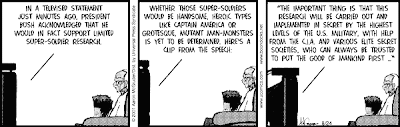
McGruder, Aaron. Cartoon. "The Boondocks". Universal Press. Chicago Tribune. Teusday March 24, (Discontinued March 26, 2006). 3/28/09 .
The Boondocks is a notoriously controversial comic strip invented by Aaron McGruder, that combats many dark concepts other comics fear involvement in. This primarily includes: Racism, Justice, Ignorance, War, Cultural Divides, Entertainment, Advertising, Drugs, and Politics. The strip's main character is Huey Freeman (the name Huey being a reference to Huey P. Newton, the cofounder of the Black Panthers), a young black who adjusts to life in a white suburb of Maryland after moving from Chicago. Pretty much every one in Huey's immediate environment is a caricature or a stereotype, giving rise to a wealth of comedic situations when these extreme personalities are in conflict with Huey's cool, pessimistic rationalism. McGruder commonly rips on politics by representing political figures, particularly the president, as being relatively true to their real selves, but placed in fantastical situations. One of the longest running repeat set-up jokes in The Boondocks, involves Huey sitting in a chair with a newspaper and either reading an article in which the president is quoted, or watching a fictional press conference on television. The president's statements are either based on something he has recently said (often a direct quote), or are fabricated based on the moral implications of recent political action. For one week, president Bush was featured in every strip giving opinions on Super Soldiers, conflicting heavily with his stances on science research and general morality, and seeking justification through divine right. McGruder's work has been discontinued and cut from multiple newspapers, the most recent form of the cartoon to date is in the form of a television show on cartoon network's late-night block, Adult Swim. The Boondocks is undoubtedly the most contentious strip to appear weekly in major American newspapers, and has gotten panned multiple times for being racist and politically insensitive; but the take home message is ultimately of the struggle for black America, and how those who reinforce negative stereotypes and proliferate ignorance within the black community, facilitate it's abuse and suppression at the hands of white society and the U.S government.

George Washington


This clip is an independent work by comic artist Brad Neely. This work typifies the up-and-coming grassroots style absurdist comedy that has become increasingly popular in America today. The themes of this clip transcend from skewed representations of history to the modern day. The comedic elements of this piece are fairly forward, and it thrives on a lack of subtlety. The schoolyard style meme of over dramatic humor is the driving force behind this clip, appropriately entitled "George Washington". Our favorite founding father and first president is endlessly over touted in mainstream american culture, and this serves to be a satirical exaggeration of the tendencies of hero-worship. This clip takes all of these aggrandized qualities of masculinity and rebelliousness commonly attributed to our nation's founders, and continues to stretch them far beyond the point of realism, leading to comedic tall tales. This trend of mounting fantastic qualities, normally occurring slowly over time as the previous exaggeration becomes routinely accepted, is sped up, manifesting itself in things like Washington's comically increasing height, and growing number of genitalia. This style of themed build is used over and over again, as seen in the statement about Washington holding an opponent's wife's hand... in a jar of acid... at a party. Neely is a comic book artist from Texas who attended the Pennsylvania Academy of the Fine Arts. His first breakout works were the series Creased Comics, and the cult hit, Wizard People, which a full length voice over of the first Harry Potter film. In the past few years his involvement in the television block "Adult Swim", and the increasing popularity of his internet video comics have brought him closer to the limelight. This particular clip was an early work, which he unwittingly sold the character rights to for $250. 

Daniel Lewkow-Identity Politics


Sarah Silverman. "I Love You More." Youtube. March 26, 2007. April 1st, 2009. http://www.youtube.com/watch?v=rNshMFbyMzw&feature=PlayList&p=ADDCED3E81E1814A&playnext=1&playnext_from=PL&index=3.

The song "I Love You More", performed by Sarah Silverman, exhibits a meddling of identity politics. Sarah Silverman innocently mocks African-Americans, Jews, Asians, Gays, and Puerto Ricaans by using sterotypes. These sterotypes run counter to anything that is politically correct, and would naturally infuriate anyone who values identity poltics. The performance, however, mocks Silverman herself, painting her as ignorant and is a satirical portrait of a bigot.